What Kind of Plans for Families Emergency Disaster
"Sometimes it takes a natural disaster to reveal a social disaster."
Jim Wallis
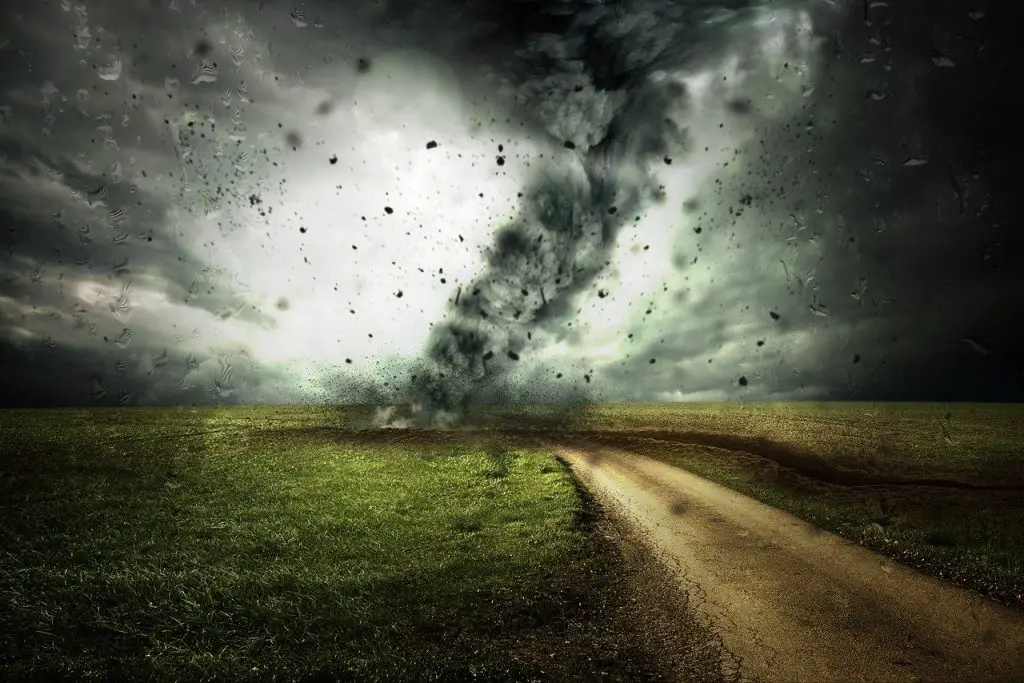
A natural disaster can be divers as a significant adverse outcome resulting from the earth's natural processes.
Natural disasters often have severe consequences for many people and also for animals and plants.
It normally also destroys buildings and thus leads to a loss of peoples' homes.
Due to the global warming result, natural disasters volition become more common in the future.
Therefore, mankind has to be prepared to deal with these adverse events.
In the following, the types, causes, effects, solutions and also examples concerning the natural disaster problem will be examined.
- Geological
- Hydrological
- Meteorological
- Wildfires
- Space disasters
Geological disasters include avalanches, landslides, volcanic eruptions, sinkholes and earthquakes.
The primary hydrological disasters are floods, limnic eruptions and tsunamis.
Meteorological disasters include blizzards, cyclonic storms, hailstorms, ice storms, heat waves, cold waves, thunderstorms, droughts and tornadoes.
Wildfires are natural disasters that occur naturally due to droughts and lightning but are also often caused by humans.
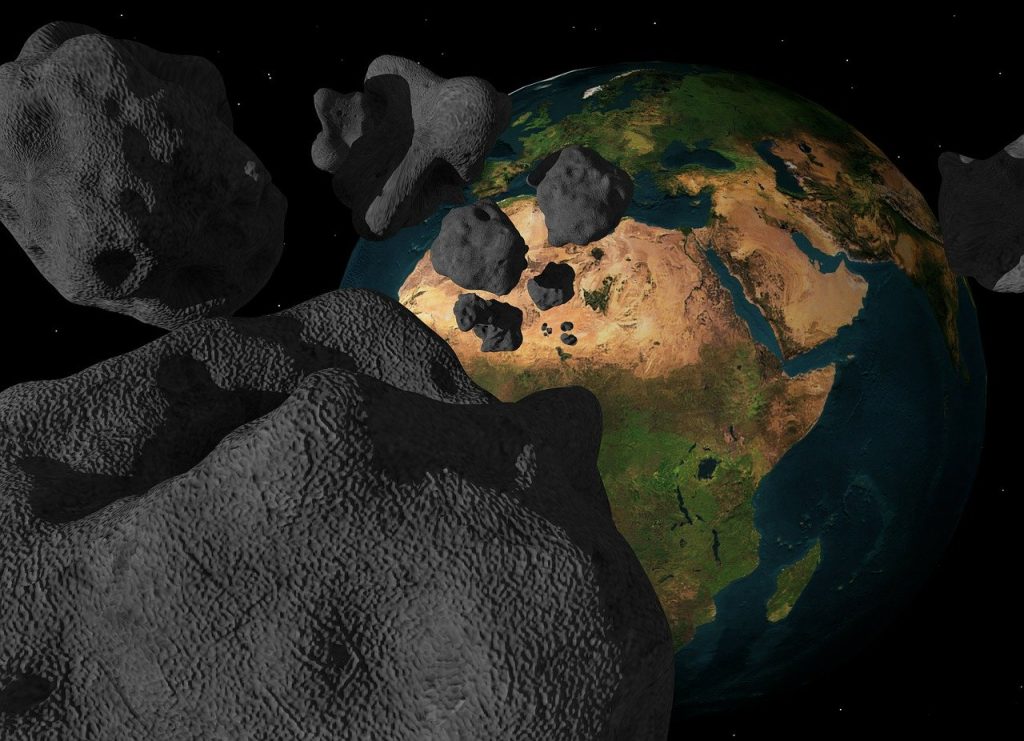
Space disasters include impact events of meteors or asteroids and solar flare.
Impact events mean that the earth will be eventually hit by a meteor or asteroid.
Solar flare refers to an event when the sun releases large amounts of solar radiation, which tin destroy our electrical equipment on globe if the radiation is strong enough.
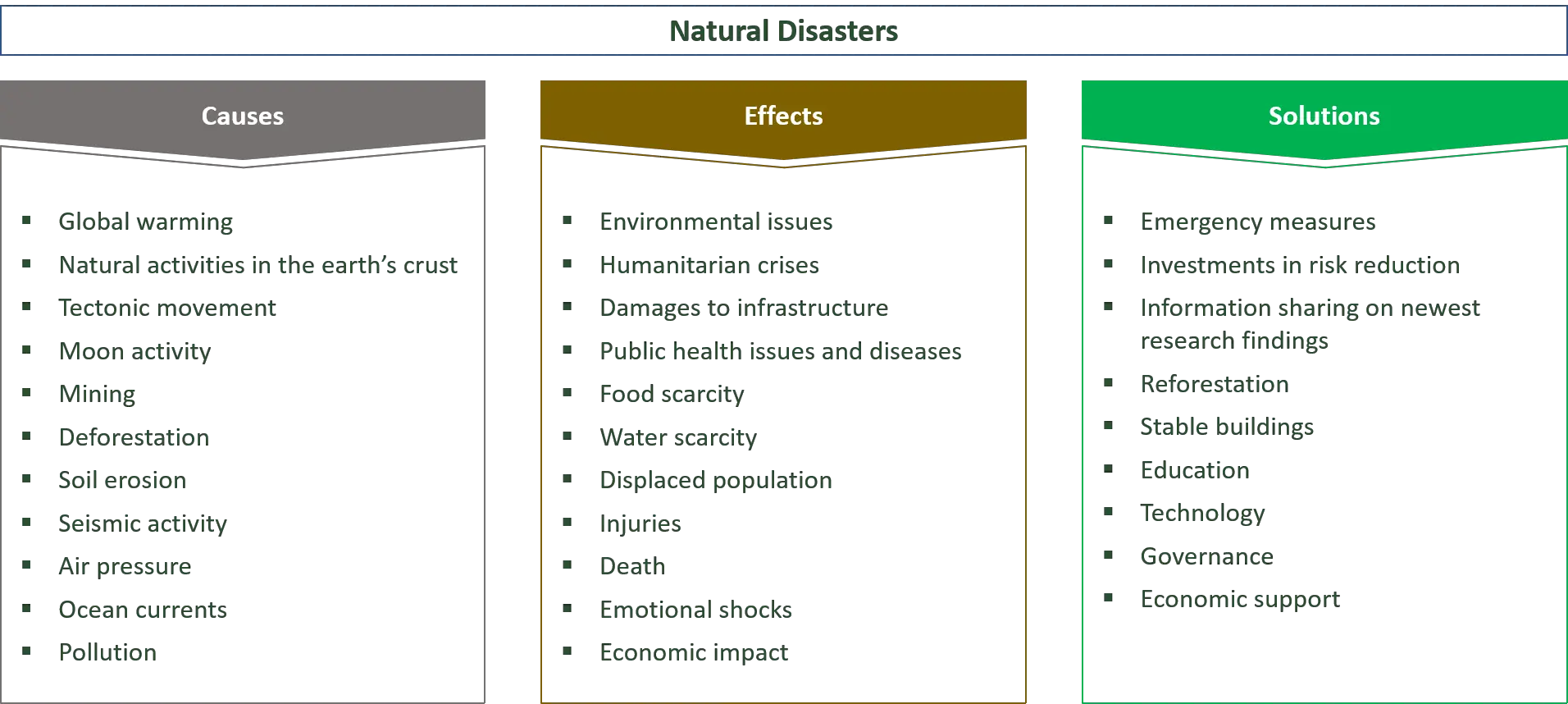
- Global warming
- Natural activities in the earth'southward crust
- Tectonic movement
- Moon activeness
- Mining
- Deforestation
- Soil erosion
- Seismic activity
- Air pressure
- Ocean currents
- Pollution
Global warming is a dandy cause of natural disasters since it affects our planet in several unlike ways.
Global warming leads to an increase in temperature of oceans, which in turn leads to more than and stronger hurricanes and tropical storms since hurricanes get their energy from the seawater.
Moreover, the probability of droughts increases since the planet'due south average temperature increases.
It is quite hard to show the causal connection betwixt climate change and natural disasters since in that location are many other variables, simply the increment of natural disasters over the last decades likely leads to the decision that global warming is a major correspondent to natural disasters.
Natural disasters are also caused by natural activities in the chaff of the globe.
Natural processes can crusade tension within the earth'south crust which are sometimes released through earthquakes.
Since the world is not made upward of i single surface but instead of many plates sliding on our planet's underlying mantle, a shift or collision of these plates can take astringent adverse furnishings.
This can atomic number 82 to earthquakes, volcanic eruptions and tsunamis.
The moon is known to have a strong influence on the natural processes on world.
Co-ordinate to latest studies, researchers establish that the moon has the potential to cause huge earthquakes which may cause huge amounts of destruction and expiry.
It is controversial whether mining activities can cause natural disasters.
Some scientists arraign mining for landslides and soil and mountain erosions.
Others debate that landslides occur naturally due to heavy rainfalls and flash floods.
Mining can thus potentially contribute to the emergence of natural disasters, although information technology is not a main driver.
Deforestation can contribute to an increase in natural disasters since forests commonly prevent floods and droughts since they balance and hold back natural groundwater resources.
By deforestation, the ground is no longer covered and thus the probability for floods and droughts increases dramatically.
Soil erosion can lead to a high level of degradation of country, which in plow tin can lead to a loss in fertility and thus to dearth for local populations.
Soil erosion can also crusade landslides which can cause serious damage to nature as well as to humans.
The seismic activities inside our earth tin can cause earthquakes.
These earthquakes can cause expiry and injuries for many people also as for animals and other life forms.
Information technology also leads to a loss of many homes and then that people who survived often have to leave their dwelling countries in order to find a better hereafter.
In that location is a connectedness between the air pressure and some natural disasters like hurricanes, heavy rains and thunderstorms.
Thus, air pressure level naturally contributes to natural disasters in a sure way.
Changing sea currents tin can lead to a change in the sea temperature which in plough can harm or even kill large populations of fish and other sea animals and plants.
Moreover, changing currents and therefore a possible local increase in water temperature tin can lead to a higher probability for hurricanes or tropical storms.
Since our nature is a quite sensitive organism, pollutions of all sorts may lead to an imbalance of the earth which in plow may create natural disasters of several sorts.
- Environmental bug
- Humanitarian crisis
- Damages to infrastructure
- Public wellness issues and diseases
- Nutrient scarcity
- Water scarcity
- Displaced population
- Injuries
- Fatalities
- Emotional shocks
- Economic impact
At that place are severe effects of natural disasters on the whole ecology system.
Hurricanes and other storms can destroy the lives and also the livelihood of many people, especially of those who live near the declension since they are likewise in danger of tsunamis.
Moreover, draughts may atomic number 82 to a migration of many people who just will no longer be able to make their living in their home countries since there is not enough water left to grow plants or to raise cattle.
Natural disasters not only accept dramatic furnishings on humans but they also destroy the habitat of many animals and plants which may in the worst case even become extinct.
Natural crises lead to humanitarian catastrophes all over the globe.
This includes an increase of dearth and besides the spread of diseases, especially in poor developing countries since they will oftentimes not exist able to fight the consequences of natural disasters in an effective way due to a shortage and resources and too due to a lack of technological knowledge.
Natural disasters may strength many people to migrate to other countries since their livelihood has been destroyed and thus, they will strive to search for a ameliorate life in other places on earth.
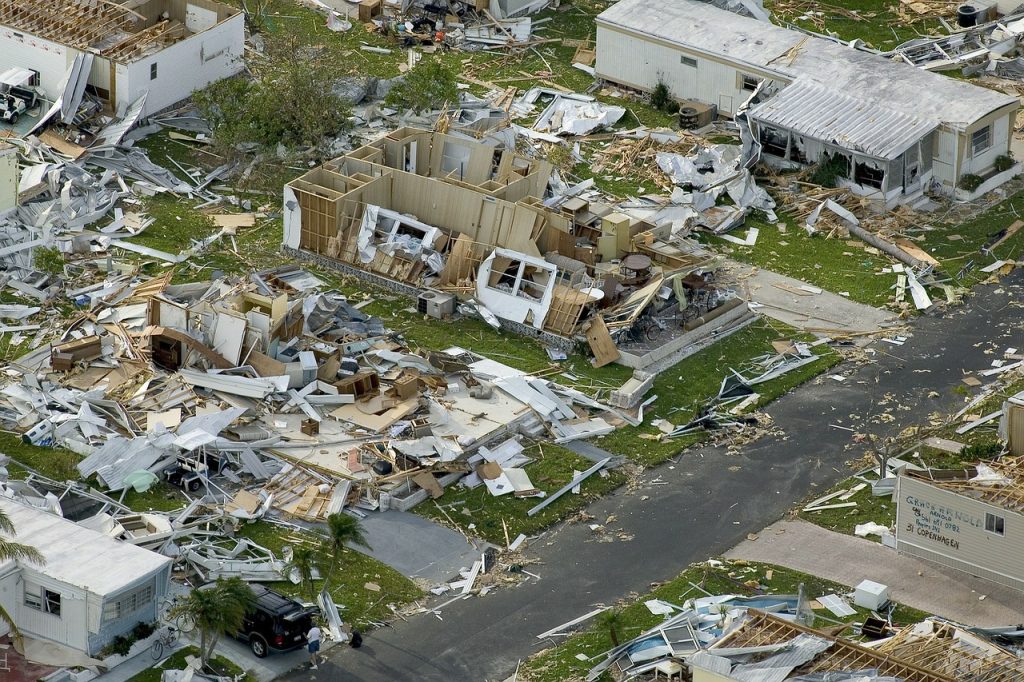
Natural disasters normally also imply corking damage to the afflicted infrastructure.
This includes the destruction of important buildings similar hospitals or airports.
Moreover, roads may be blocked through trees and thus the transportation system may collapse as a upshot of natural disasters.
Natural disasters often destroy many important facilities that are meant to proceed living conditions stable.
If these facilities are destroyed, there will probable be an increase in diseases since the hygienic atmospheric condition dropped equally a consequence of the natural disaster.
Making things worse, natural disasters often too destroy hospitals and other medical facilities.
This ways non only the likelihood of diseases increases due to lower hygienical standards, also the supply of medicines will be more difficult.
Equally a issue, it is more than likely that people volition not be able to recover from their diseases.
Another effect of natural disasters can be a scarcity of resources, which is especially astringent when information technology comes to the supply of nutrient.
If large areas of state have been destructed by natural disasters, farmers will no longer be able to harvest plenty crops or to heighten enough cattle in gild to meet the demand.
Thus, the local population is likely to suffer from starvation.
Another related issue is the topic of water scarcity.
Due to natural disasters, natural water sources like rivers or lakes may be polluted and thus the water supply will exist decreased dramatically.
A scarcity of water supply volition be especially severe when droughts hit areas for a long period of time.
Farmers will no longer exist able to raise plenty crops.
Moreover, fifty-fifty the drinking water volition get a scarce resources which may eventually lead to migration since water is essential for all life on earth.
Due to natural disasters, people often lose all their belongings, including their houses and their livelihood.
If this happens, they have to decide if they will be able to rebuild all of it or if they instead run across a better chance to move to other countries in order to be able to notice a amend future there.
There will be an increasing number of migrants in the time to come due to the fact that global warming volition greatly reduce the fertility make many areas since at that place will not exist enough h2o left to grow crops or to raise cattle.
Thus, many people will exist forced to leave their homes and to drift to other countries.
Many people will suffer from injuries caused by natural disasters.
Making things worse, medical treatment in the affected areas volition be quite limited since many medical facilities may have been destructed likewise.
It will therefore not be possible to treat many injuries in an effective way which may cause adverse long-term health effects.
Many people lose their lives equally a effect of natural disasters.
Natural forces are simply too potent to relieve all people.
Moreover, especially in developing countries, alert systems are often not good enough to be able to relieve the lives of many people.
In add-on, medical facilities are oft not avant-garde enough and will not be able to deal with a large number of heavily injured people at one time, which may result in increased mortality.
Apart from physical injuries, many people will as well suffer from mental weather since they will not be able to process and handle the consequences of natural disasters accordingly.
Many people lose their children or other family members to natural disasters which will shock them emotionally for quite a long time or even for their whole life.
It volition take a long time for many people to recover from these kinds of emotional horrible events.
To brand things worse, there are normally great adverse economical effects from natural disasters.
For example, an convulsion can atomic number 82 to a devastation of large areas of land.
People will no longer be able to make their living from farming in these areas.
Thus, they will lose their livelihood because of the upshot of this disaster.
- Emergency measures
- Investments in chance reduction
- Information sharing on newest inquiry findings
- Reforestation
- Stable buildings
- Educational activity
- Applied science
- Governance
- Economical support
Since we will non be able to entirely terminate the occurrence of natural disasters, it is crucial to practice our best to mitigate the adverse effects.
This means having effective early on warning systems in place which advise people to search for shelter before natural disasters hitting.
Moreover, the medical facilities have to be secured against natural disasters so that injured people will be able to get medical support.
In addition, governments in high-hazard countries should make agreements to aid each other in case one land is afflicted by a natural disaster.
With these emergency measures, the effects of natural disasters tin can exist mitigated to a meaning degree, even though we volition never be able to protect all people from the horrible adverse effects.
Investments in hazard reduction may also protect people from the adverse effects of natural disasters.
This could mean taking prevention measures fifty-fifty before natural disasters occur.
For example, countries tin build barriers which in case of a seismic sea wave prevent it from hitting the declension.
It is crucial that countries all over the world share their newest findings and insights on measures for how to protect people from the effects of natural disasters.
Since developed countries normally accept larger budgets for research, they should supply developing countries with insights that assist these countries to accept action confronting natural disasters.
Reforestation is an effective measure against some natural disasters, peculiarly against landslides, droughts and floods.
The roots of trees concur the soil together and also store large amounts of water.
Moreover, reforestation is also a counter-measure to the issue of global warming.
Global warming also contributes to an increase in natural disasters since it increases the sea temperature which contributes to more powerful storms.
Thus, reforestation tin can indirectly contribute to a decrease in the probability of hurricanes and other storms.
Nosotros have to make certain that our buildings are able to survive strong storms and also earthquakes.
This is possible with our current knowledge, still, information technology takes quite advanced building techniques in order to accomplish this kind of buildings.
Moreover, poor countries may ofttimes take not the noesis nor the resource to build stable homes.
Thus, especially people in these countries must improve in order to be more than resistant to natural disasters.
Information technology is in the responsibility of developed countries to provide help and share insights in lodge to make buildings more resistant to natural disasters, also in poor countries.
Educational activity plays an important role in the context of natural disasters.
On the one mitt, information technology helps people to empathise how they contribute to natural disasters in their daily lives.
For case, our consumption behavior leads to an increase in the speed of global warming which in plough leads to more storms.
On the other hand, education also helps people in the sense that they volition be taught how to behave in instance of emergency and thus to be able to salvage their lives.
Technology is an of import part of the overall picture to deal with natural disasters.
Although we will never be able to fully forbid all kinds of natural disasters, technology can aid to mitigate the adverse consequences of these events.
For instance, improved early on warning systems tin save many lives which would otherwise be lost due to tsunamis or other natural disasters.
Emergency plans on how to conduct in case of natural disasters take to be prepared and improved past governments in the affected areas over time.
Through profound emergency plans, many people will exist able to survive natural disasters.
Governments have to make sure that these plans are up to date and as well suit them when they go new insights.
Since the biggest natural disasters oft happen in poor countries, rich adult countries tin help them with financial back up in gild to recover from the adverse consequences.
For example, it will take lots of money to rebuild the destroyed infrastructure.
This tin can be achieved much faster if financial support is supplied past other countries.
The Shaanxi convulsion in 1556 is considered the deadliest earthquake in recorded history and killed approximately 830,000 people.
In 1839, Coringa, a port metropolis in Bharat, had been hitting past a massive cyclone which caused the death of 300,000 people.
The Haiphong typhoon hit parts of Vietnam and the Philippines in 1881 and caused more than 300,000 fatalities.
The Yellow River Alluvion happened in 1887 on the Huang He river in China.
It killed around 900,000 people and is therefore ranked as one of the deadliest natural disasters in history.
The Haiyuan earthquake in 1920 Haiyuan County in China. It caused more than than 270,000 deaths.
The Bhola whirlwind in 1970 stroke both Bharat and Pakistan and caused more than 500,000 fatalities.
It is therefore known equally the deadliest tropical cyclone in the recorded history.
In 1976, an earthquake hit the region of Tangshan in China.
More than than 240,000 people died considering of this natural disaster.
Hurricane Andrew was a hurricane of category 5 that hitting the Commonwealth of the bahamas, Louisiana and Florida.
Although the number of fatalities was relatively low, the economic damage was one of the largest in history and amounted to 27.3 billion USD.
The Bam earthquake happened in 2003 in Iran and killed around 26,000 people.
The epicenter of the Indian bounding main earthquake in 2004 was in Sumatra, Republic of indonesia.
Information technology also caused a seismic sea wave. The estimated fatalities amount to over 225,000.
The category 5 Hurricane Katrina hit Louisiana and Florida in 2005.
It caused over k fatalities and the damage amounted to 125 billion USD.
The earthquake in Kashmir, Pakistan in 2005 caused between 80,000 and 90,000 fatalities.
Additionally, millions of people had to be displaced.
The Sichuan earthquake in Cathay in 2008 caused almost 90,000 deaths and acquired harm amounting to 150 billion USD.
Cyclone Nargis hit Myanmar in 2008 and is known as the worst natural disaster in the history of the country.
It is estimated that this whirlwind acquired around 140,000 fatalities.
The earthquake in Haiti in 2010 caused massive destruction.
The estimates of fatalities range between 100,000 and over 300,000, depending on the source.
The 300,000 estimate is the official number released past the government.
In 2011, the Tōhoku earthquake off the coast of Nihon caused effectually xvi,000 deaths.
Natural disasters are a groovy threat to humanity.
Although they occurred long before the first human populated the planet, we likely contribute to an increase in natural disasters through our behavior.
The number of natural disasters seems to be positively correlated to an increase in the globe's temperature.
Since we contribute to global warming through the emission of greenhouse gases, we also indirectly contribute to an increment in natural disasters.
All the same, we will not be able to entirely foreclose natural disasters to happen.
Instead, nosotros should amend our emergency measures in order to save as many people as possible.
All countries should work together in club to mitigate the problem of natural disasters and ensure a livable futurity for future generations.
Sources
https://en.wikipedia.org/wiki/Natural_disaster
https://ourworldindata.org/natural-disasters
https://www.who.int/environmental_health_emergencies/natural_events/en/

About the author
My name is Andreas and my mission is to educate people of all ages near our environmental problems and how everyone can make a contribution to mitigate these issues.
As I went to university and got my Master's degree in Economics, I did plenty of research in the field of Evolution Economics.
After finishing university, I traveled around the world. From this time on, I wanted to make a contribution to ensure a livable future for the next generations in every part of our beautiful planet.
Wanna make a contribution to relieve our environment? Share it!
Source: https://environmental-conscience.com/causes-effects-solutions-for-natural-disasters/
0 Response to "What Kind of Plans for Families Emergency Disaster"
Postar um comentário